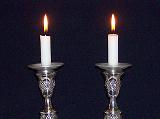
1) It is forbidden to utilize the "light" of the Chanukah candles for any purpose. (Shulchan Aruch Siman 673).
This applies to all the candles that were kindled for that night, even though the extra candles are only for "Hiddur Mitzvah- beautification of the Mitzvah",e.g. on the fifth night, one may not "use" any of the 5 candles, even though Min HaDin only one candle must be kindled each night. (See Be'er Heitev ibid.)
The "uses" that are prohibited include mundane uses such as counting money by the lights of the menorah, as well as holy purposes, such as davening or learning Torah via the light of the menorah.
2) Some opinions allow using the light of the menorah for holy purposes (opinion of the Ba'al HaItur and other Rishonim, brought in the Tur), but the consensus of virtually all Poskim, and the prevalent practice, is to prohibit even holy uses. (Magen Avraham, Levush, Elya Rabbah, Aruch HaShulchan etc.)
It is for this reason that the widespread minhag is to add an extra candle, known as the "Shamash" to the menorah each night, this way when/if you "use" the light of the menorah it will be the light of that candle that we are using and not the lights of the menorah.
The "Shamash" should be placed a little higher than the other candles so it should be evident that it isn't one of the "Mitzvah candles". (Ram'a Siman 670:2)
All the menorahs that are being lit require their own "shamash", even if there is other light in the room. (See Magen Avraham Siman 670:5 and Mishna Berura 670:18)
Halachos for Shabbos Kodesh
1) Many otherwise righteous Jews have a "custom" to play "Kvitlach", a gambling card game (Basically a poker type game with a Jewish sounding name to make it seem kosher) on Chanukah.
It isn't clear exactly where this minhag came from or how it developed, but it isn't a proper Minhag, but rather a sinful expression of "empty partying" that has replaced the "Shiros V'Tishbachos, praising of Hashem that used to (and still should) characterize Chanukah celebrations, and one who values his/her soul should avoid these card games at all costs. (Biur Halacha Siman 670)
2) Those who play "Kvitlach"on Chanukah will be punished severely in the next world, as many other Aveiros, sins, are inevitably involved whenever these card games take place (gambling, stealing, Nivul Peh, Bitul Torah, Prikus Ol, Lashon Hara, [as well as lack of Tzniyus, Histaklus B'Arayos etc. when there are men and women involved in the same game, Chas V'Shalom] just to name a few).
One who has the capacity to stop these games from taking place and discontinue this sinful practice will be greatly rewarded in the next world (Aruch HaShulchan Siman 670:9. See also Yesod V'Shoresh Ha'Avodah Sha'ar 12: end of Perek 1)
If you have been invited to participate in such a game, it would be best to cancel and let them know that you won't be attending. Although this may be a difficult decision and one that may cause you embarrassment and "hard feelings", it is the right decision and one that a G-d fearing Jew must make. The Mishna in Pirkei Avos teaches us that "L'Fum Tzaarah Agrah- the more painful a [right] decision is to make, the greater the heavenly rewards" (See also Kedushas Levi, Derushei Chanukah, where he too decries the practice of card playing on Chanukah)
QUESTION & ANSWER CORNER
Reader Submitted Questions of interest on topics related to Halachos we covered, as well as other interesting topic and Answers.
These Q&A are taken from the Q & A pages on the Halacha For Today website.
Although the answers I give to questions are taken directly from the Sifrei HaPoskim, and aren't my own, they are still for study purposes only, NOT for Psak Halacha. Questions can be emailed to HalachaForToday@Gmail.com
Reader's Question:
Is there a way to be able to wear gloves on shabbos?
Answer:
If they are firmly tied on to the coat it is less of a problem according to some Poskim. (See Biur Halacha Siman 301:37)
If not, although there are lenient opinions on which many people rely, it is best for a Yerei Shomayim to avoid wearing gloves on Shabbos.(See Shulchan Aruch Siman 301:37 and Mishna Berura S"K140 and 141)
In extreme weather conditions where there is no chance they will be removed, many Poskim allow it. Additionally, many Poskim are more lenient for women and allow them to wear gloves even when they arent tied to the coat.
[All of the above is when there is no Eruv, as within an Eruv they may be worn of course, as the problem with gloves in the first place is lest they be removed in Reshus Harabim and be carried more than 4 Amos.]
For Halacha L'Ma'aseh a Rav must be consulted.
CHIZUK CORNER
This section is dedicated L'Ilui Nishmos the Telzer Rosh Yeshiva, HaRav Chaim Yaakov Stein Zatzal and the Mir Rosh Yeshiva, HaRav Noson Tzvi Finkel Zatzal. May we all strive to follow in their ways and may they both be Melitzei Yosher for all of Klal Yisroel.
We will B'Ezras Hashem post here each day a short inspirational thought to help us all improve our lives and grow in our service of our Father in heaven, HaKadosh Baruch Hu.
IF YOU HAVE SOMETHING MEANINGFUL FOR THIS SECTION, PLEASE EMAIL IT TO HalachaForToday@Gmail.com
THANK YOU AND תזכו למצות!
זכר צדיקים וקדושים לברכה
A wise man was asked, "is there anything a person can do to alleviate his desire for revenge, since the Torah forbids acting vengefully?"
He answered, "do something to improve yourself. When you become a better person, it will torment your enemies to no end!"
Rabbi Doctor Abraham J. Twerski quoted in Sefer Torah Tavlin
1) It is forbidden to utilize the "light" of the Chanukah candles for any purpose. (Shulchan Aruch Siman 673).
This applies to all the candles that were kindled for that night, even though the extra candles are only for "Hiddur Mitzvah- beautification of the Mitzvah",e.g. on the fifth night, one may not "use" any of the 5 candles, even though Min HaDin only one candle must be kindled each night. (See Be'er Heitev ibid.)
The "uses" that are prohibited include mundane uses such as counting money by the lights of the menorah, as well as holy purposes, such as davening or learning Torah via the light of the menorah.
2) Some opinions allow using the light of the menorah for holy purposes (opinion of the Ba'al HaItur and other Rishonim, brought in the Tur), but the consensus of virtually all Poskim, and the prevalent practice, is to prohibit even holy uses. (Magen Avraham, Levush, Elya Rabbah, Aruch HaShulchan etc.)
It is for this reason that the widespread minhag is to add an extra candle, known as the "Shamash" to the menorah each night, this way when/if you "use" the light of the menorah it will be the light of that candle that we are using and not the lights of the menorah.
The "Shamash" should be placed a little higher than the other candles so it should be evident that it isn't one of the "Mitzvah candles". (Ram'a Siman 670:2)
All the menorahs that are being lit require their own "shamash", even if there is other light in the room. (See Magen Avraham Siman 670:5 and Mishna Berura 670:18)
Halachos for Shabbos Kodesh
1) Many otherwise righteous Jews have a "custom" to play "Kvitlach", a gambling card game (Basically a poker type game with a Jewish sounding name to make it seem kosher) on Chanukah.
It isn't clear exactly where this minhag came from or how it developed, but it isn't a proper Minhag, but rather a sinful expression of "empty partying" that has replaced the "Shiros V'Tishbachos, praising of Hashem that used to (and still should) characterize Chanukah celebrations, and one who values his/her soul should avoid these card games at all costs. (Biur Halacha Siman 670)
2) Those who play "Kvitlach"on Chanukah will be punished severely in the next world, as many other Aveiros, sins, are inevitably involved whenever these card games take place (gambling, stealing, Nivul Peh, Bitul Torah, Prikus Ol, Lashon Hara, [as well as lack of Tzniyus, Histaklus B'Arayos etc. when there are men and women involved in the same game, Chas V'Shalom] just to name a few).
One who has the capacity to stop these games from taking place and discontinue this sinful practice will be greatly rewarded in the next world (Aruch HaShulchan Siman 670:9. See also Yesod V'Shoresh Ha'Avodah Sha'ar 12: end of Perek 1)
If you have been invited to participate in such a game, it would be best to cancel and let them know that you won't be attending. Although this may be a difficult decision and one that may cause you embarrassment and "hard feelings", it is the right decision and one that a G-d fearing Jew must make. The Mishna in Pirkei Avos teaches us that "L'Fum Tzaarah Agrah- the more painful a [right] decision is to make, the greater the heavenly rewards" (See also Kedushas Levi, Derushei Chanukah, where he too decries the practice of card playing on Chanukah)
QUESTION & ANSWER CORNER
Reader Submitted Questions of interest on topics related to Halachos we covered, as well as other interesting topic and Answers.
These Q&A are taken from the Q & A pages on the Halacha For Today website.
Although the answers I give to questions are taken directly from the Sifrei HaPoskim, and aren't my own, they are still for study purposes only, NOT for Psak Halacha.
Questions can be emailed to HalachaForToday@Gmail.com
Reader's Question:
Is there a way to be able to wear gloves on shabbos?
Answer:
If they are firmly tied on to the coat it is less of a problem according to some Poskim. (See Biur Halacha Siman 301:37)
If not, although there are lenient opinions on which many people rely, it is best for a Yerei Shomayim to avoid wearing gloves on Shabbos.(See Shulchan Aruch Siman 301:37 and Mishna Berura S"K140 and 141)
In extreme weather conditions where there is no chance they will be removed, many Poskim allow it. Additionally, many Poskim are more lenient for women and allow them to wear gloves even when they arent tied to the coat.
[All of the above is when there is no Eruv, as within an Eruv they may be worn of course, as the problem with gloves in the first place is lest they be removed in Reshus Harabim and be carried more than 4 Amos.]
For Halacha L'Ma'aseh a Rav must be consulted.
CHIZUK CORNER
This section is dedicated L'Ilui Nishmos the Telzer Rosh Yeshiva, HaRav Chaim Yaakov Stein Zatzal and the Mir Rosh Yeshiva, HaRav Noson Tzvi Finkel Zatzal. May we all strive to follow in their ways and may they both be Melitzei Yosher for all of Klal Yisroel.
We will B'Ezras Hashem post here each day a short inspirational thought to help us all improve our lives and grow in our service of our Father in heaven, HaKadosh Baruch Hu.
IF YOU HAVE SOMETHING MEANINGFUL FOR THIS SECTION, PLEASE EMAIL IT TO HalachaForToday@Gmail.com
THANK YOU AND תזכו למצות!
זכר צדיקים וקדושים לברכה
A wise man was asked, "is there anything a person can do to alleviate his desire for revenge, since the Torah forbids acting vengefully?"
He answered, "do something to improve yourself. When you become a better person, it will torment your enemies to no end!"
Rabbi Doctor Abraham J. Twerski quoted in Sefer Torah Tavlin
1)The ideal time to light the Chanukah Menorah is between "sunset" and the time that people are no longer in the street.(Talmud Shabbos 21b)
The Rishonim debate what "sunset" in this case means, as the setting of the sun is divided into 3 time periods. The three times [for lighting the Menorah] are:
a) As soon as the sun begins setting, though it is still very light outside. (Opinion of the Rambam, Mordechai, Rav Hai Gaon)
b) The beginning of the sun's actual setting, when it is starting to get dark already [approximately 20-40 minutes after "sunset"] (Opinion of the Rashba, Ran, Meiri, Ritva[though the Ritva allows lighting at the earlier time of sunset as well])
c) The end of Sunset, which is referred to as "Tzais HaKochavim- when three stars are visible in the sky". (Opinion of Tosefos, Manhig, The Rosh, Tur, Terumas HaDeshen)
2) There are many different opinions amongst the Poskim as far as which of the above opinions is best to follow.
Many people [especially in America] follow the minhag of Rav Moshe Feinstein Zatzal who lit the Menorah approximately 10 minutes after Sunset. (Based on the Opinion of the Gaon of Vilna in Biur HaGr"a Orach Chaim Siman 672. There is a contradictory Biur HaGr"a in Yoreh Deah Siman 266:17 who seems to say that the best time to light is at "Tzeis Hakochavim- when the stars appear" which is definitely later than 10 minutes after sunset. See Sefer Moadim U'Zmanim from Rav Moshe Sternbuch Shlita , Vol. 2 Siman 154 how he deals with this apparent contradiction). This is also the minhag of Maran HaRav Yosef Shalom Elyashiv Shlita.
Many people [especially in Eretz Yisroel] follow the minhag of the Chazon Ish Zatzal to wait an additional 10 minutes, and light only 20 minutes after sunset. This was also the Minhag of the Steipler Zatzal.
The Minhag of Rav Ahron Kotler Zatzal was to light 25-30 minutes after sunset.
Many people follow various other minhagim, and each person should adopt the custom of their own family, or consult a Rav if no custom is in place.
Even those who follow the Gr"a and light at the earliest time, should make sure there is enough oil (or the candles be long enough) to burn until a half hour past "Tzeis HaKochavim" (Psak of Rav Chaim Kanievsky Shlita, quoted in Sefer Yemei Halel V'Hoda'ah)
QUESTION & ANSWER CORNER
Reader Submitted Questions of interest on topics related to Halachos we covered, as well as other interesting topic and Answers.
These Q&A are taken from the Q & A pages on the Halacha For Today website.
Although the answers I give to questions are taken directly from the Sifrei HaPoskim, and aren't my own, they are still for study purposes only, NOT for Psak Halacha.
Questions can be emailed to HalachaForToday@Gmail.com
Reader's Question:
Can someone use a meat thermometer on Shabbos (the kind that pokes into the meat and gives the internal meat temperature) if it is not a digital read-out?
Answer:
No, it is prohibited to measure on Shabbos for purposes other than healing or for a Mitzvah.
Also, there may also be an issue of heating up the liquid in the thermometer when it is inserted into the hot meat.
CHIZUK CORNER
This section is dedicated L'Ilui Nishmos the Telzer Rosh Yeshiva, HaRav Chaim Yaakov Stein Zatzal and the Mir Rosh Yeshiva, HaRav Noson Tzvi Finkel Zatzal. May we all strive to follow in their ways and may they both be Melitzei Yosher for all of Klal Yisroel.
We will B'Ezras Hashem post here each day a short inspirational thought to help us all improve our lives and grow in our service of our Father in heaven, HaKadosh Baruch Hu.
IF YOU HAVE SOMETHING MEANINGFUL FOR THIS SECTION, PLEASE EMAIL IT TO HalachaForToday@Gmail.com
THANK YOU AND תזכו למצות!
זכר צדיקים וקדושים לברכה
We don't have to travel to be happy. We don't have to go outside the country. In your own house, teach your family the blessing that Hashem is giving us.
If we come home on Shabbos and the sun is shining, remark: "How sweet is the light, what a pleasure is the sunshine!" Sunlight means happiness.
Every minute, new sunlight is being delivered to the earth and that sunlight and gives us our food and our energy and shouldn't we thank Hashem all day long?
Teach your children to be happy with sunlight. Do you know what a gift that is? But the greatest of gifts is that these phenomena teach us knowledge about Hashem.
- HaRav Avigdor Miller Zatzal -
WWW.SIMCHASHACHAIM.COM
THE DAVENING CORNER - Part II
This segment was compiled by Moshe Weiss, S. Weiss, and E. Willner of Brooklyn, NY.
For those of you who missed the original segments, please e-mail mw@mosheweiss.com.
GENERAL RULE: Emphasis (shown here by bold and italics) is usually on the last syllable. Look for a vertical line in (most) siddurim if the emphasis is on a different syllable.
WEEK TWO:
Be careful not to interchange letters such as fay and vais. Lifnay and livnay are two distinct words. Lifnay chisei chevodecha (in Asher Yatzar) means before or in front of your throne. Livnay Yisra-ale means to the children ofYisra-ale.
The same thing applies to zayin and samech. In Shemoneh-Esrei the correct pronunciation is "Vezocher chasday avos", not chazday avos. Although in this case you are not saying a different word, you are saying nonsense.
1) All Jews are obligated in the Mitzvah of lighting Chanukah candles.
This applies to men, women and children above the age of Chinuch (approximately 5 or 6 years of age), as all Jews were saved in the miraculous victory of the Maccabees over the mighty Greek army. (Additionally, as we discussed in the previous Halachos, women are specifically obligated in the Mitzvos of Chanukah, due to their being saved from the harsh decrees levied against them, via the heroic act of Yehudis, a woman)
2) The prevalent Minhag is for the male head of household to exempt all the female members of the house (adults and children alike), through the lighting of his menorah.
The females being exempted should make sure to be present and listen to the recital of the Brachos [and answer Amen] while the menorah is kindled. (Mishna Berurah Siman 675:9)
Of course, if no man is available to exempt her, a women should light [and make the blessings over] her own menorah. A woman can also exempt other people with her lighting, when no man is available to do this. (See Smag Hilchos Chanukah and Taz Siman 675:3)
Boys who have reached the age of Chinuch should preferably light their own menorahs [with all the Halachic details involved] and not rely on the head of the household's lighting. (Ram'a Siman 675:3. See also Mishna Berura and Biur Halacha ibid. Dibur Hamaschil U'Ldidan, regarding if there is a Mitzvah of Chinuch for "Hidur Mitzvah" or just for the "letter of the law" and thus children would only have to light one candle per night.)
QUESTION & ANSWER CORNER
Reader Submitted Questions of interest on topics related to Halachos we covered, as well as other interesting topic and Answers.
These Q&A are taken from the Q & A pages on the Halacha For Today website.
Although the answers I give to questions are taken directly from the Sifrei HaPoskim, and aren't my own, they are still for study purposes only, NOT for Psak Halacha.
Questions can be emailed to HalachaForToday@Gmail.com
Reader's Question:
What is the Halacha regarding using dishes that have not been used for at least 15 -20 years. They are fine bone china, but I know they did not come from a kosher home?
Answer:
Usually china cannot be koshered.
If they are expensive, and havent been used in over a year ( as is your case) some Poskim alow them to be koshered and used.
Consult a Rav for halacha L'Ma'aseh.
CHIZUK CORNER
This section is dedicated L'Ilui Nishmos the Telzer Rosh Yeshiva, HaRav Chaim Yaakov Stein Zatzal and the Mir Rosh Yeshiva, HaRav Noson Tzvi Finkel Zatzal. May we all strive to follow in their ways and may they both be Melitzei Yosher for all of Klal Yisroel.
We will B'Ezras Hashem post here each day a short inspirational thought to help us all improve our lives and grow in our service of our Father in heaven, HaKadosh Baruch Hu.
IF YOU HAVE SOMETHING MEANINGFUL FOR THIS SECTION, PLEASE EMAIL IT TO HalachaForToday@Gmail.com
THANK YOU AND תזכו למצות!
זכר צדיקים וקדושים לברכה
"V'Nakeh Lo Yinakeh", and acquit Hashem does not acquit (Ki Sisa 34:7). This pasuk is the source of the Midas HaDin and all the troubles that seem to befall us in life. The Gaon HaKadosh MiKozhnitz tells us that if you take the words V'Nakeh and Yinakeh, and remove the letters Kuf and Nun from each of these words, the remaining letters are the Shem HaShem.
This is the meaning of the mishna in Pirkei Avos (4:27), "Al Tistakel B'KanKan Eleh B'Ma SheYesh Bo", don't look at the jug, only what is in it. Kan and Kan are the exterior of our Tzaros. We tend to focus on our pain rather than the underlying issue. The Mishna tells us when we are in a situation of Nakeh Lo Yinakeh, we should not focus on the facade which is the Kuf Nun Kuf Nun, but rather the remaining letters of Hashem. We must realize that within this ordeal, Hashem is close to us and holding our hand. Everything is directed by Hashem for a good reason and we should use it to get close to Him.
Rav Yehuda Asad says that this is what we say on Chanukah in Maoz Tzur, "UMiNosar Kankanim Naaseh Nes LaShoshanim". From the Shem Hashem that stood behind the wars and the tzaros of Antiochus, which were merely empty jugs testing our resolve, Naaseh Nes LaShoshanim, a great miracle occurred for those who passed the test and came out smelling like roses.
Submitted by daily reader, M.K.; Taken from www.Revach.net
1) During Chanukah it is proper to strengthen ourselves in the areas of learning Torah, Davening and Gemilas Chasadim.
( See Pri Megadim Siman 670 at length for a fascinating explanation how
the Greeks were trying to prevent the Jews from upholding the three
pillars of the world: Torah, Avodah and Gemilas Chasadim and thus we
need to intensify our efforts precisely in these areas.)
2)
It is customary to give extra Tzedakah during the days of Chanukah,
especially to support poor people who spend their lives dedicated to
learning Torah. (See Kitzur Shulchan Aruch Siman 139:1)
The Yesod V'Shoresh H'Avodah (Sha'ar 12:1) expounds
on this, based on the Zohar Hakadosh and the Kisvei Ha'Arizal and
writes that one who is lax with the giving of Tzedakah all year round
can rectify the harm this laxity caused by increasing his/her giving of
Tzedakah during Chanukah, especially if giving to support those who
learn Torah.
QUESTION&ANSWER CORNER
Reader
Submitted Questions of interest on topics related to Halachos we
covered, as well as other interesting topic and Answers.
Although
the answers I give to questions are taken directly from the Sifrei
HaPoskim, and aren't my own, they are still for study purposes
only, NOT for Psak Halacha. Questions can be emailed to HalachaForToday@Gmail.com
Reader's Question:
If someone said Al Hamichya [after eating bread] in place of bentching should he still bentch or was he Yotzai with Al Hamichya?
Answer:
He should still Bentch, as even if M'Doraysa he may have satisfied his obligation, M'Drabanan he has not.
Furthermore,
there is a requirement to mention "Bris and Torah" in Bentching, and
those are missing in Al HaMichya. See Shulchan Aruch Siman 187:3. and
Sha'ar Hatziyun Siman 168:71.
See also Shu"t Az Nidberu Vol. 5 Siman 31.
CHIZUK CORNER
This
section is dedicated L'Ilui Nishmos the Telzer Rosh Yeshiva, HaRav
Chaim Yaakov Stein Zatzal and the Mir Rosh Yeshiva, HaRav Noson Tzvi
Finkel Zatzal. May we all strive to follow in their ways and may they
both be Melitzei Yosher for all of Klal Yisroel.
We
will B'Ezras Hashem post here each day a short inspirational thought to
help us all improve our lives and grow in our service of our Father in
heaven, HaKadosh Baruch Hu.
1)
The Minhag is that women do not do "Melacha" (work or chores) for the
first thirty minutes after the Chanukah menorah is lit.
Some have this Minhag on each of the eight nights of Chanukah (Shibolei HaLeket).
Others have this Minhag only on the first and last night of Chanukah. (Shiltei Giborim, Kol Bo, MaHaril and others)
According
to some opinions, the type of "Melacha" that the women shouldn't do is
any "Melacha" that is prohibited on any other Yom Tov.(Levush, Bach, Rav Shlomo Zalmen Auerbach Zatzal and others).
According
to other opinions, however, only Melachos that women refrain from doing
on Rosh Chodesh and Chol HaMoed are prohibited, such as sewing,
laundry, ironing etc., but baking, cooking and the like is allowed.
(Moed L'Kol Chai, Rav Moshe Feinstein Zatzal, Debreciner Rav in Be'er
Moshe, Rav Chaim Kanievsky Shlita in the name of his father the Steipler
Zatzal)
2) Some Poskim maintain that the minhag not to do Melacha applies to men as well. (Elya Rabba's understands of the MaHaril, Bach and a few others).
Most
Poskim however, maintain that this is a special Minhag for women only,
as they had particularly harsh decrees targeting them (namely
that all Jewish brides were required to spend the night with the Greek
general before being allowed to be with their husbands) and they also had a special part in the miracle of Chanukah
(referring to the story of Yehudis who slayed the Greek general, before
he was able to defile her and through her heroic actions, the decree
was abolished. See Tosafos Pesachim 108b Dibur Hamaschil HaYu B'Oso
Ha'Nes and Rama Siman 670:2. See also Rashi to Shabbos 21b Dibur
Hamaschil V'Asum that there is no Issur Melacha on Chanukah)
QUESTION&ANSWER CORNER
Reader
Submitted Questions of interest on topics related to Halachos we
covered, as well as other interesting topic and Answers.
Although
the answers I give to questions are taken directly from the Sifrei
HaPoskim, and aren't my own, they are still for study purposes
only, NOT for Psak Halacha. Questions can be emailed to HalachaForToday@Gmail.com
Reader's Question:
Have any poskim commented on the customs of Nittel Nacht (the custom of not learning Torah on the Christian holiday of Xmas)?
If
most Jews in fact observed this custom, and no Torah was studied for
part or all of the night, couldn't this put the entire universe in
jeopardy, since if the world was left for a moment without Torah study
the world would disappear?
Answer:
There is much debate
about this minhag and many Poskim reject it, but it clearly has many
sources in the Poskim who do indeed rule this way, most relating to the
danger in days of old of Jews being seen in the streets that night or
even having a candle lit in their homes, thus resulting in no learning
that night.
Another reason, cited in
the name of Rav Nosson Adler Zatzal, the Chasam Sofer's Rebbi, is that
this night was established as a time of mourning for all the
persecutions of the Jewish nation due the birth being celebrated on this
day by the Christians, and thus just as on Tisha B'Av it is forbidden
to learn, so to this night. See Sefer Nitei Gavriel Page 388 footnote 4.
See also Ta'amei Haminhagim page 500 for other reasons.
Regarding your second
question, being that it isnt the same date and time in all parts of the
world, and given that many people don't have this custom or lived in
parts of the world where there was no threat, learning Torah was never
brought to a total halt. If it ever halted, the world would indeed cease
to exist. (Many Tzadikim indeed would be careful to learn Torah at
times when most of the world was busy with other things, such as on
Purim, Motzei Yom Kippur and other such times)
CHIZUK CORNER
This
section is dedicated L'Ilui Nishmos the Telzer Rosh Yeshiva, HaRav
Chaim Yaakov Stein Zatzal and the Mir Rosh Yeshiva, HaRav Noson Tzvi
Finkel Zatzal. May we all strive to follow in their ways and may they
both be Melitzei Yosher for all of Klal Yisroel.
We
will B'Ezras Hashem post here each day a short inspirational thought to
help us all improve our lives and grow in our service of our Father in
heaven, HaKadosh Baruch Hu.
What is wrong with the quality of envy, and what are some practical ways to work on it?
Answer by HaRav Avigdor Miller Zatzal:
Envy is a glorious
mechanism that Hakadosh Baruch Hu bestowed on mankind, in order to
achieve perfection. Envy is a way of acquiring good things that you
don't have. Kin'ah means the word Konoh to acquire; only Kin'ah means
you want to take from somebody else. Like Shoresh means, L'hashrish to
put root, L'sharesh to pull out the roots. Sokol, to throw stones,
L'sakeil, to take out stones.
So Konoh
means to acquire, and Kin'ah means to take away what someone else has
acquired. So therefore, if you see somebody has good practices, it's
good to be envious. Be jealous of good things. When people are polite:
you see a man and his wife talk politely to each other, you come home
and practice it to your own wife. Be jealous. When you see people who
are standing a long Shmonei Esrei, try to stand a longer one. People are
learning; try to learn too. All good things are facilitated by Kin'ah.
Kin'as Sofrim Tarbeh Chochmah; the envy of book-men increases wisdom.
That's why Hashem gave Kin'ah.
Only when
you don't intend to acquire any good things, only you don't want that
person to have it, that's wicked Kin'ah. You're jealous because he has
it, that's wicked Kin'ah. Also material things: you have a right to try
to better yourself, you have a right to buy a better house, better
furniture. But that it should eat you up? That means your head is on the
wrong subjects. Why aren't you eaten up when other people are more
pious and more decent than you are? But that kind of Kin'ah also is
wickedness. How to work on Kin'ah, that's a different subject, it needs
more than this lecture, some other time.
To subscribe to the weekly "A moment with Rabbi Miller" emails, Click Here.
The Talmud (Shabbos 21b, also quoted in the Tur beginning of Hilchos Chanukah) asks the following question: "Mai Chanukah, What is Chanukah"?
Rashi explains the Talmud's question to mean, "Due to which miracle was the Yom Tov of Chanukah instituted?"
The Talmud goes on to answer the question as follows: On the 25th day of the month of Kislev begin the eight days of Chanukah. It is prohibited to eulogize anyone on these days and it is prohibited to fast on these days.
Why?
When the Greeks entered the Bais HaMikdash they[handled all the vessels and touched and] made all the oil [that was used to light the menorah] impure. When the Chashmonaim (sometimes referred to as the Macabees) overpowered the Greek army and won the war they searched the entire Bais HaMikdash and were only able to find one small jug of pure oil [with the seal of the Kohen Gadol on it].
There was only enough oil in this jug to light the menorah for one day. However, a miracle occurred and the small amount of oil was sufficient to light the menorah for eight days (until they were once again able to purify themselves and produce more oil).
The following year, beginning on 25 Kislev, the Chachamim instituted an eight day Yom Tov (which we refer to as Chanukah) dedicated to Halel (praise) and Hoda'ah (Thanks) [to Hashem].
1) According to many Rishonim there is no requirement to have a Seudah (festive meal) on Chanukah, and any Seudah that is made is a Seudas Reshus (non-obligatory meal).
Others argue and maintain that there is indeed a requirement to have a Seudah, with bread, on Chanukah.
The prevalent minhag when having a Seudah on Chanukah is to sing Shiros V'Tishbachos (praises) to Hashem and/or talk Divrei Torah, thus making it a Seudas Mitzvah according to all opinions.
2) It is customary to eat foods made with cheese on Chanukah in commemoration of the miracle of Yochanan Kohen Gadol's daughter, Yehudis, slaying the Greek general Heliphornius which is considered one of the miracles of Chanukah, in which cheese played a role. (See Ram"a Siman 670:2 and Mishna Berura S"K 10. for more of the story.)
QUESTION & ANSWER CORNER
Reader Submitted Questions of interest on topics related to Halachos we covered, as well as other interesting topic and Answers.
These Q&A are taken from the Q & A pages on the Halacha For Today website.
Although the answers I give to questions are taken directly from the Sifrei HaPoskim, and aren't my own, they are still for study purposes only, NOT for Psak Halacha.
Questions can be emailed to HalachaForToday@Gmail.com
Reader's Question:
Can a mourner for a parent (an Avel) , within the twelve months of mourning, lead Mincha on Erev Shabbos ?
What are the sources for your decision ?
In addition, does a mourner within the twelve months lead Mincha and/or Maariv on Chanukah ?
Answer:
The Poskim discuss the times when an Avel should not daven, and I have not found anyone who says that Mincha on Erev Shabbos is one of those times(That doesnt mean that the opinion doesn't exist, it just means I didn't find it).
In fact, in the Sefer Pnei Baruch (Siman 35) he quotes the father of the Shl"a HaKadosh who says that on days when Tachnun is not recited (which would presumably be the reason for the minhag not to daven on Erev Shabbos at Mincha, if such a minhag even exists) it is in fact a Mitzvah for an Aveil to daven for the Amud.
The Mishna Berura too (Siman 581:7) writes that one may daven on a day that Tachnun isn't recited. In fact the Pnei Baruch also writes there that this that Aveilim do not daven on Shabbos is only a minhag, but there is no Issur!
The time when the Aveilim do not daven is when "LamnaTzeach ...Yaancha Hashem B'Yom Tzara/Tziduk HaDin" is not recited. And even then it is a Machlokes HaPoskim as to which Tefilos are better for an aveil not be the Shliach Tzibbur for.
On Rosh Chodesh some Poskim say that an Avel should not daven at all, while others maintain that only for Halel and Musaf he shouldn't lead, but Shachris, Maariv and Mincha are OK. Others maintain that for Shachris too he shouldnt be the ba'al Tefilah. (See Mishna Berura ibid.)
On Chanukah an Aveil may daven Mincha and Maariv, but not Shachris and Halel. (See Mishna Berura 683:1 and 671:44)
There are Poskim who maintain that on Chanuka, even for Mincha and Maariv, an Aveil should not daven for the Amud (Shu"t Rivevos Ephraim Vol. 1 Siman 443 says this was the opinion of Rav Moshe Feinstein Zatzal. See also Shu"t Divrei Moshe Siman 84)
For a final ruling, a Rav should be consulted, of course or at least the Gabbai of the Shul who may know the "Minhag HaMakom", which should always be followed.
CHIZUK CORNER
This section is dedicated L'Ilui Nishmos the Telzer Rosh Yeshiva, HaRav Chaim Yaakov Stein Zatzal and the Mir Rosh Yeshiva, HaRav Noson Tzvi Finkel Zatzal. May we all strive to follow in their ways and may they both be Melitzei Yosher for all of Klal Yisroel.
We will B'Ezras Hashem post here each day a short inspirational thought to help us all improve our lives and grow in our service of our Father in heaven, HaKadosh Baruch Hu.
IF YOU HAVE SOMETHING MEANINGFUL FOR THIS SECTION, PLEASE EMAIL IT TO HalachaForToday@Gmail.com
A man stopped HaRav Caim Ozer Grodzinsky Zatzal, the Rav of Vilna and the Gadol and Posek Hador in the pre-WWII era, to ask for directions how to get to his destination.
This man was stuttering, so Rav Chaim Ozer not only gave him directions but also walked him all the way to his destination.
The students asked why? R Chaim Ozer answered "If I didn't take him there he might have needed to ask direction again and then he might get embarrassed."
Today's
Halachos are dedicated by daily reader, C.S., in loving memory of her
father, Yosef ben Avraham A"H , whoseYahrtzeit is this Shabbos, 14
Kislev. May his Neshama continue to go higher and higher in Gan Eden and
may he be a Meilitz yosher for his family.
1)
Based on the "ninety days" logic we discussed yesterday, another
halachically acceptable option to "train" the brain to say "V'Sein Tal
U'Matar L'Vracha" in the winter or to say "V'Sein Bracha" in the summer,
is to say 90 times in succession the entire segment of the Bracha,
"...V'Es Kol Minei SevuAsah L'Tovah, V'Sein Tal U'Matar L'Vracha (or
"V'Sein Bracha" in the summer) Al Pnei Ha'adama"
2) Once this is done, anytime we are in doubt we can assume that it was said with the proper insertion. (See Shulchan Aruch Siman 114:9 and Mishna Berura S"K 39-44)
Halachos for Shabbos Kodesh
1) This method of reciting the words ninety times, applies to "Mashiv HaRuach U'Morid HaGeshem" as well.
In
fact, in many Yeshivos they have a minhag, dating back to pre-war
Europe, to sing with a special tune the words "Mechayeh Meisim Atah Rav
L'Hoshea, Mashiv HaRuach U'Morid HeGeshem Mechalkel Chaim..." ninety
times on the day that Tefilas Geshem is recited, in order to ingrain in
their brains to say it properly during Shemona Esrei.
2)
All the Halachos regarding the guidelines of when to repeat Shemona
Esrei when one omitted "V'Sein Tal U'Matar", "V'Sein Bracha", "Mashiv
HaRuach", Ya'aleh V'yavo" etc. apply equally to men and women.
***
Beginning next week, B'ezras Hashem, we will begin discussing some Halachos of Chanukah.
QUESTION&ANSWER CORNER
Reader
Submitted Questions of interest on topics related to Halachos we
covered, as well as other interesting topic and Answers.
Although
the answers I give to questions are taken directly from the Sifrei
HaPoskim, and aren't my own, they are still for study purposes
only, NOT for Psak Halacha. Questions can be emailed to HalachaForToday@Gmail.com
Reader's Question:
A few
weeks ago, I was at Target and the cashier gave me 2 pairs of shoes for
free because I joked that they're free because they didn't have a price
on it.
I was happy but obviously I doubt the cashier had authority to give me the shoes.
I asked my family and they said one is allowed to steal from a non Jew.
I
know you have to return something if it will cause a kiddush Hashem,
but in this case the shoes were worth 40 dollars and if the only reason I
would have to return would be to make a kiddush Hashem, then I opted
not to because the 40 dollars is a lot for me.
So I was wondering what the halacha would be here and in general from stealing from a non Jew?
Answer:
Geneivas Akum, Stealing from a non Jew is 100% prohibited,
and may even be a worse sin than stealing from a Jew. (See Shulchan
Aruch Choshen Mishpat Siman 348:2, Kitzur Shulchan Aruch Siman 182:1 and
Ben Ish Chai Parshas Ki Seitzei.)
"If
one steals from a non -Jew, swears falsely and dies, his death is no
atonement for his sin because of Chillul Hashem" (Tosefta Bava Kamma, 10
quoted in facinating, must read essay on Chilul Hashem written by Rav
Shimon Schwab Zatzal which can be seen here).
Ta'us Akum, where a non Jew made an error in your favor, is where it may be permissible, if no Chilul Hashem is involved.
In your case, you must return the shoes.
[editor's
postscript: A day after receiving the above question, I received an
email from this person telling me that both pairs of shoes which were in
a bag in the car, were stolen from the car.]
CHIZUK CORNER
This
section is dedicated L'Ilui Nishmos the Telzer Rosh Yeshiva, HaRav
Chaim Yaakov Stein Zatzal and the Mir Rosh Yeshiva, HaRav Noson Tzvi
Finkel Zatzal. May we all strive to follow in their ways and may they
both be Melitzei Yosher for all of Klal Yisroel.
We
will B'Ezras Hashem post here each day a short inspirational thought to
help us all improve our lives and grow in our service of our Father in
heaven, HaKadosh Baruch Hu.
The Midrash says: One must take a lesson in forgiveness from
Avraham Avinu. When Avimelech took Sarah away he caused Avraham
tremendous suffering; yet when Avimelech asked to be forgiven, he
forgave him immediately. Moreover, he davened for the wellbeing of
Avimelech and his family.
(מדרש הגדול וירא כ, יז)
The Midrash
relates that when Yosef HaTzaddik was in the pit, his brother Shimon had
him stoned. Nevertheless, when Shimon fell in his hands in Mitzrayim,
he took good care of him and had him served the best delicacies. The
Zohar writes that like Yosef, one should repay evil with good.
(ילקוט שמעוני וישב קמ"ב, תניא ספי"ב)
The tanna R.
Abba was once sitting near the entrance of Lud and witnessed the
following scene. A weary traveler sat down on a boulder protruding from
the edge of a mountain, and fell asleep. As he was sleeping, a snake
crept out and was making its way towards him, when suddenly another
creature attacked the snake and killed it, saving the man's life.
When the man
woke up, he walked away, and at that moment the protruding boulder broke
off the mountain and tumbled down the cliff. R. Abba approached the man
and said, "Tell me what special deed you have done to merit these two
great miracles. They must have been earned."
The man replied,
"When anyone wrongs me, I immediately make up with him. At any rate, I
do not go to bed before forgiving him. I then try to be extra kind to
them in the future."
R. Abba said:
This man's actions are greater than those of Yosef, for this man forgave
people who were not his brothers, on whom one is inclined to have
mercy.
It is for this
reason that before krias shma al hamitah, we recite Ribbono shel Olam,
forgiving anyone who may have hurt us throughout the day.
(זהר מקץ רא ע"ב, וראה מגילה כח ע"א)
Submitted by daily reader, M.F.; Taken from the weekly L'Maan Yishmeu email. To subscribe send request to info@lmaanyishmeu.com
1) After thirty days of saying "V'Sein Tal U'Matar" in the winter, or saying "V'Sein Bracha" in the summer we assume that one's brain is already used to saying the proper text.
Thus, if after this time period one doesn't remember if the proper text was said, we assume that indeed it was and we do not require him/her to repeat Shemona Esrei.
2) The magical "thirty days" is not so much due to its being a month, rather it is due to having ninety Tefilos prayed in that period, and once something is said or done ninety times, it becomes "second nature".(In fact, something that is done, or not done, for ninety days, is scientifically proven to become easier to maintain. This is true for breaking addictions as well as for changing other human habits etc.) (See Mishna Berura Siman 114:37)
QUESTION & ANSWER CORNER
Reader Submitted Questions of interest on topics related to Halachos we covered, as well as other interesting topic and Answers.
These Q&A are taken from the Q & A pages on the Halacha For Today website.
Although the answers I give to questions are taken directly from the Sifrei HaPoskim, and aren't my own, they are still for study purposes only, NOT for Psak Halacha.
Questions can be emailed to HalachaForToday@Gmail.com
Reader's Question:
I've been trying to find a makor (source) for the direction one turns during "Bo-ee V'shalom" during kabalas Shabbos. It would seem that one should turn to one's right, just like any other mitzvah; however, I seem to recall seeing in a Sefer that EVERYONE should actually turn towards his LEFT, but I don't recall why (I think he was quoting the Munkatcher Rav?)
In any case, can you help provide me with a makor?
Answer:
During the recitation of the last verse of the Lecha Dodi, Bo'ee V'Shalom, the Pri Megadim and other Seforim say to turn to Maariv, westward, which is to the back of the shul.
In the Siddur of Rav Yaakov Emden Zatzal he says in the name of his father the Chacham Tzvi Zatzal that when saying the first "Bo'ee Kallah" he would bend his head to his left, which is to the right of the Shechina and when he said the second "Bo'ee Kallah" he would bend his head to the right.
See also Ben Ish Chai, second year Parashas Vayeira Siman 2 for a detailed discussion about this.
#
CHIZUK CORNER
This section is dedicated L'Ilui Nishmos the Telzer Rosh Yeshiva, HaRav Chaim Yaakov Stein Zatzal and the Mir Rosh Yeshiva, HaRav Noson Tzvi Finkel Zatzal. May we all strive to follow in their ways and may they both be Melitzei Yosher for all of Klal Yisroel.
We will B'Ezras Hashem post here each day a short inspirational thought to help us all improve our lives and grow in our service of our Father in heaven, HaKadosh Baruch Hu.
IF YOU HAVE SOMETHING MEANINGFUL FOR THIS SECTION, PLEASE EMAIL IT TO HalachaForToday@Gmail.com
THANK YOU AND תזכו למצות!
זכר צדיקים וקדושים לברכה
THE DAVENING CORNER - Part II
This segment, which we will post weekly B'Ezras Hashem, was compiled by daily readers, Moshe Weiss, S. Weiss, and E. Willner of Brooklyn, NY.
For those of you who missed the original segments and are interested in reading them, please e-mail mw@mosheweiss.com and they will email it to you.
Rabbi Pesach Krohn was once speaking about the importance of keeping quiet in shul especially during Chazaras Hashatz (repetition of Shemoneh-Esrei.) He explained that the person at the amud is acting as our defense attorney in a court of law. He is pleading for Hashem's mercy to give us blessings in our lives. Imagine someone convicted of murder and facing death row sitting in court as his attorney is trying to defend him and prove that he is not guilty. If he started talking to the person behind him or talking on his cell phone, it would look like he doesn't give any credence or respect to the person trying to get him acquitted of the serious charges against him. If he shows the court that he does not care about his own future, why should the jury or judge care about him either?
By ignoring our defense attorney, who is the chazzan in our case, and talking when he is pleading our case, we are showing that we don't care about our future. So then, why should Hashem, the ultimate Judge in this world, listen to the words of our shaliach tzibbur? It is important for our defense attorney to represent us to the Ribono Shel Olam correctly, by clearly saying the correct words. This approach is extended to ba'alei keriah as well. Not correcting a mistake or mispronunciation which would change the meaning of a word could invalidate the keriah. The strictness applied to them to properly pronounce the words they lein should be applied by individuals to their own tefillos as well.
GENERAL RULE: Emphasis (shown here by bold and italics) is usually on the last syllable. Look for a vertical line in (most) siddurim if the emphasis is on a different syllable.
WEEK ONE:
In the birchos hatorah every morning, when saying "asher bachar banoo mikol ha-ameem venasan lanoo es toraso," we are praising and thanking Hashem that He chose us from all the other nations and gave us the Torah. This berachah is also said when a man gets an aliyah to the Torah.
Banoo with the accent on the first syllable means in us. Banoo with the accent at the end means they built. Mispronounced, this would mean "he chose 'they built' from all the other nations."
Likewise, lanoo with the accent on the first syllable means to us. Lanoo with the accent at the end means they slept.
This shows us that the berachah loses its proper meaning when pronounced incorrectly.
1) If during the time period that "V'Sein Tal U'Matar" was supposed to be said, one can't recall if he/she remembered to say it, if it is in within the first thirty days of when it was added to the Tefilah, we assume that one was still used to the old text of "V'Sein Bracha" and thus did not remember to add "V'Sein Tal U'Matar", and therefore must follow the guidelines outlined in yesterday's Halachos regarding repeating the Shemona Esrei. (See Shulchan Aruch Siman 114:8 and Mishna Berura S"K 37)
2) The same thirty day rule applies to after Pesach when "V'Sein Bracha" is supposed to be added, and one cannot recall if he/she remembered to say it or inadvertently kept saying "V'Sein Tal U'Matar L'Vracha" as was etched in their brain for the past few months.
We will discuss the "thirty days" more in detail tomorrow B'Ezras Hashem
QUESTION & ANSWER CORNER
Reader Submitted Questions of interest on topics related to Halachos we covered, as well as other interesting topic and Answers.
These Q&A are taken from the Q & A pages on the Halacha For Today website.
Although the answers I give to questions are taken directly from the Sifrei HaPoskim, and aren't my own, they are still for study purposes only, NOT for Psak Halacha.
Questions can be emailed to HalachaForToday@Gmail.com
Reader's Question:
Why is it not permitted to blow bubbles on Shabbos?
Answer:
The reason the Poskim say not to blow bubbles is that doing so is Nolad, creating something new that was not in existence before Shabbos out of something else that was.
Also, it's Uvda D'Chol, a weekday activity. For small children we can be lenient and allow it.
CHIZUK CORNER
This section is dedicated L'Ilui Nishmos the Telzer Rosh Yeshiva, HaRav Chaim Yaakov Stein Zatzal and the Mir Rosh Yeshiva, HaRav Noson Tzvi Finkel Zatzal. May we all strive to follow in their ways and may they both be Melitzei Yosher for all of Klal Yisroel.
We will B'Ezras Hashem post here each day a short inspirational thought to help us all improve our lives and grow in our service of our Father in heaven, HaKadosh Baruch Hu.
IF YOU HAVE SOMETHING MEANINGFUL FOR THIS SECTION, PLEASE EMAIL IT TO HalachaForToday@Gmail.com
THANK YOU AND תזכו למצות!
זכר צדיקים וקדושים לברכה
Question:
How does one deal with frustration of the necessity to work for a living, and not being able to learn as much Talmud and other Sifrei Kodesh as he would like?
Answer by HaRav Avigdor Miller Zatzal:
We have to realize that in this world Hakadosh Baruch Hu is doing things that are good for us. Gedola Melacha, how great is work; work causes a man to have excellence of character. What you think would be the best thing for you to do, is not necessarily so.
When people sit by themselves, many times they develop selfishness and arrogance. But because they have to get along with other people, they have to please their employer, take care of their employees, they have to kowtow to customers, and it changes their nature.
And people, when they are dutiful and loyal, they become different, and Hakadosh Baruch Hu certainly intends that benefit too.
Of course, if you are a wealthy man and you don't have to work and you are able to subject yourself to a Rebbe, become a Talmid, and follow the sedorim of a Yeshiva, very good. Whatever it is however, Hakadosh Baruch Hu sends to you what's necessary for your protection, and people should not complain.
If you're sending children to the Yeshiva, your girls are being taught in frum schools, and it's a house where they are growing up not only with Kashrus, but also with Derech Eretz and Yiras Shamayim, so you're maintaining a Torah institution. The fact that you are working, is the same as people who are working to raise money for a Yeshiva.
So supporting your Torah family is a very noble ideal.
1) If the Bracha of Shma Koleinu was finished and there too "V'Sein Tal U'Matar L'Vracha" was omitted, if the Bracha of "Retzei" was not yet started, "V'Sein Tal U'Matar L'Vracha" can be said right then and there. (Shulchan Aruch Siman 117:5)
2) If one already began "Retzei", as long as one is still in middle of Shemona Esrei (i.e. did not say the second "YihYu L'Ratzon in Elokai Netzor for those who say it twice. See Mishna Berura Siman 117:18), he/she should go back to the beginning of the Bracha of "Bareich Aleinu" and say from there until the end of Shemona Esrei again, and this time remember to say "V'Sein Tal U'Matar L'Vracha". (ibid.)
If one already finished the entire Shemona Esrei, he/she needs to repeat the entire Shemona Esrei from the beginning. (ibid.)
Reader's Question:
Where is the makor (source) in minhagim seforim or even Halacha to give gifts on Chanukah?
I strongly believe it is none other than chukas hagoyim one hundred percent.
Chanukah gelt perhaps has a source, however, this business of giving gifts? Where does that originate from?
I am hoping that perhaps you can change my opinion.
Answer:
The Poskim disucuss this and conclude that it isn't a problem of Chukas HaGoyim, as in all likelihood the Goyim's minhag of giving gifts on their holidays was taken from us and not vice verca. (See Emes L'Yaakov from Rav Yaakov Kamenetskky Zatzal Siman 670 in the footnote.)
The Ponovez Rav, Rav Yosef Shlomo Kahaneman Zatzal said that after the greeks forbade the Jewish children from learning Torah, their parents had to "bribe" them with gifts to get them to learn once again. Giving gifts on Chanukah commemorates that aspect of the Chanukah miracle.
Indeed, children should be told when receiving gifts that it is for this reason and that they are expected to increase their Torah learning because of the gifts. (See Sifsei Chaim from Rav Chaim Friedlander Zatzal; Moadim Vol. 2 page 134)
See also Shu"t Avnei Yashfeh Vol. 1 Siman 129:2 and Sha'arei Halacha U'Minhag Vol. 2 page 283
CHIZUK CORNER
This section is dedicated L'Ilui Nishmos the Telzer Rosh Yeshiva, HaRav Chaim Yaakov Stein Zatzal and the Mir Rosh Yeshiva, HaRav Noson Tzvi Finkel Zatzal. May we all strive to follow in their ways and may they both be Melitzei Yosher for all of Klal Yisroel.
We will B'Ezras Hashem post here each day a short inspirational thought to help us all improve our lives and grow in our service of our Father in heaven, HaKadosh Baruch Hu.
IF YOU HAVE SOMETHING MEANINGFUL FOR THIS SECTION, PLEASE EMAIL IT TO HalachaForToday@Gmail.com
THANK YOU AND תזכו למצות!
זכר צדיקים וקדושים לברכה
Whatever happens in the world is for the ultimate good. Frequently we are not able to comprehend how something is for the good since suffering seems so terrible. The situation is analogous to an ill person who does not comprehend how the medication the doctor is giving him is for his good.
Rabbi Zelig Pliskin in his book "Gateway to Happiness"
1) If one omitted "V'Sein Tal U'Matar L'Vracha" during the winter months, and they remembered while still in middle of the Bracha of "Bareich Aleinu", before saying the name of Hashem at the end, they go back and say "V'sein tal U'Matar L'Vracha" and continue from there.
2) If the name of Hashem was already recited at the end of the Bracha , do not go back, rather finish the Bracha ad continue Shemona Esrei and add in "V'sein Tal U'matar L'Vracha" during the Bracha of "Shma Koleinu". (Shulchan Aruch Siman 117:5. See Kitzur Shulchan Aruch Siman 19:6 and Kaf HaChaim Siman 117:37 that just the 4 words "V'Sein Tal U'Matar L'Vracha" are added and no further text. However, Aruch HaShulchan Siman 117:6 seems to say that the entire text of the Bracha of Bareich Aleinu is added.)
QUESTION & ANSWER CORNER
Reader Submitted Questions of interest on topics related to Halachos we covered, as well as other interesting topic and Answers.
These Q&A are taken from the Q & A pages on the Halacha For Today website.
Although the answers I give to questions are taken directly from the Sifrei HaPoskim, and aren't my own, they are still for study purposes only, NOT for Psak Halacha.
Questions can be emailed to HalachaForToday@Gmail.com
Reader's Question:
My family doesn't say "Layehudim Haysa Ora..." aloud altogether at Havdalah- is there a halachic source for everyone to say it out loud?
Answer:
My family doesn't say it loud either. It is only a Minhag. Some people say that Posuk loud, while other people do not.
From the language of the Rama in Siman 296:1 it doesn't seem that he had the minhag for anyone other than the one reciting Havdalah to say this or any other Pesukim.
CHIZUK CORNER
This section is dedicated L'Ilui Nishmos the Telzer Rosh Yeshiva, HaRav Chaim Yaakov Stein Zatzal and the Mir Rosh Yeshiva, HaRav Noson Tzvi Finkel Zatzal. May we all strive to follow in their ways and may they both be Melitzei Yosher for all of Klal Yisroel.
We will B'Ezras Hashem post here each day a short inspirational thought to help us all improve our lives and grow in our service of our Father in heaven, HaKadosh Baruch Hu.
IF YOU HAVE SOMETHING MEANINGFUL FOR THIS SECTION, PLEASE EMAIL IT TO HalachaForToday@Gmail.com
THANK YOU AND תזכו למצות!
זכר צדיקים וקדושים לברכה
Before his death, Rabbi Nochum Zev Ziv Zatzal of Kelm suffered very severe pains. He prayed that the Almighty should lessen his pain a little in order that he should be able to accept it. His sister asked him, "Ask the Almighty to completely remove your suffering. Why do you ask only for lessening of the pain and not for its disappearance?"
Rabbi Nachum Zev replied, "I am not on the highest level of treasuring suffering that I would wish for extreme pain. But I'm also not on the lowest level. Suffering has its benefits and I therefore pray to receive an amount of suffering that I will be able to accept with the proper attitude.
Rabbi Zelig Pliskin in his book "Gateway to Happiness"
Starting
today, we will take a break from Hilchos Shabbos for a short while in
order to B'Ezras Hashen study some timely halachos of "V'sein Tal
U'Matar", as well as some Hilchos Chanukah.
1) In the Bracha of "Barech Aleinu" in Shemona Esrei, the Bracha where we request Parnassah from Hashem, in the winter months we insert the words "V'Sein Tal U'Matar L'Vracha, [Hashem please] Give us dew and rain for blessing [i.e. in its right time and in abundant supply]", in place of "V'Sein Bracha, [Hashem please] give us [abundant] blessing, that is recited in the summer months." (See Mishna Berura Siman 114:14)
2) In Eretz Yisroel [and its surrounding cities] "V'Sein Tal U'Matar L'Vracha" is inserted [instead of V'Sein Bracha] beginning on the seventh day of the month of Cheshvan, whereas in Chutz L'Aretz it isn't said until sixty days after the Tekufah of Tishrei (The autumn equinox), which according to the current way of calculating falls out on December 4 th or 5th. (See
Shulchan Aruch Siman 117:1. According to the Abudreham, When February
has 28 days we start on December 4 and when February has 29 days we
start on December 5)
V'Sein Tal U'Matar is said until Erev Pesach. On Motzaei Yom Tov of the first days of Pesach, we begin saying "V'Sein Bracha". (ibid.)
QUESTION&ANSWER CORNER
Reader
Submitted Questions of interest on topics related to Halachos we
covered, as well as other interesting topic and Answers.
Although
the answers I give to questions are taken directly from the Sifrei
HaPoskim, and aren't my own, they are still for study purposes
only, NOT for Psak Halacha. Questions can be emailed to HalachaForToday@Gmail.com
Reader's Question:
In
Talmud Avoda Zora 28b it discusses whether to use a remedy [medicine]
on Shabbos. It says that vinegar is permitted as it is also a product
used as a food item and thus after rinsing the mouth, it is swallowed.
It also talks about this in Shabbos 111a.
How does this equate with using mouth wash on Shabbos. Is mouth wash used fort medicinal purposes, cleansing purposes or as a prophylactic [e.g. as a vitamin] to prevent disease?
Answer:
The use of mouthwash is permitted on Shabbos for freshening and/or cleaning one's mouth.
See
Shu"t Be'er Moshe Vol. 1 Siman 34: 7 and Shu"t Rivevos Ephraim from Rav
Ephraim Greenblatt, Talmid of Rav Moshe Feinstein Zatzal, Vol. 2 Siman
Siman 115:23
CHIZUK CORNER
This
section is dedicated L'Ilui Nishmos the Telzer Rosh Yeshiva, HaRav
Chaim Yaakov Stein Zatzal and the Mir Rosh Yeshiva, HaRav Noson Tzvi
Finkel Zatzal. May we all strive to follow in their ways and may they
both be Melitzei Yosher for all of Klal Yisroel.
We
will B'Ezras Hashem post here each day a short inspirational thought to
help us all improve our lives and grow in our service of our Father in
heaven, HaKadosh Baruch Hu.
If
the image of Jacob's ladder was not the most spectacular prophetic
vision ever, it certainly comes close. In his dream, Jacob saw a ladder
planted firmly on the ground yet reaching all the way into the heavens,
and as he watched in utter fascination, he saw angels ascending and
descending the ladder.
Then
he wakes up, and lo and behold, it was all a dream. Jacob is shaken,
and he reacts rather strangely. How can it be, he laments, that I am in
the presence of the Almighty and did not even know it? No expressions of
transcendent joy. No ecstatic expansion of the mind as a result of his
sublime prophecy. Just chagrin. Why?
Our
Sages tell us that he was mortified that he had actually slept in such a
holy place. But even this does not fully answer the question. After
all, what is so terrible about sleeping on hallowed ground? And if it
was really such a terrible transgression, why did the Almighty reward
him with this prophetic dream?
The
commentators explain that Jacob was disappointed because he had missed
an extraordinary opportunity. Had he known that he stood on hallowed
ground, had he known he was actually standing in the presence of the
Almighty, he would have concentrated on having an even more intense
prophetic encounter with Him. But he had been completely oblivious to
his surroundings. Indeed, he had gone to sleep!
He
could have risen to incredible spiritual levels. He could have attained
the most profound prophetic insights. He could have penetrated the
deepest secrets of the universe. But he went to sleep. He did have a
phenomenal prophetic vision in his dream, but that was where it stopped.
So much potential unfulfilled. Such a great opportunity lost. It is
little wonder that Jacob awoke disappointed.
A young man came to study in the academy of a great sage. He listened to the sage expound his thoughts and was
amazed at their profound wisdom. He bent over the revered texts and
pored over every single words in awe. A feeling of humility swept
through his soul.
"Oh, what a nothing I am," he muttered under his breath. "What a miserable ignorant nothing."
The sage overheard his words and called him closer.
"Young man," he said, "why do you consider yourself a nothing?"
"Because I am weak, a salve to my physical needs and desires." "I see. And why did you come here?"
"To learn from you."
"If
you wish to stay here and be successful," said the sage, "then you
cannot consider yourself a nothing. After all, if you are truly nothing,
how can you possibly retain wisdom? No, my young friend. Humility is a
very good trait, but know your own worth. Know the sublimity of your
soul and give it what it deserves."
In
our own lives, we sometimes fall asleep on hallowed ground. Driven down
by the pressures of everyday life, we can easily fall into the trap of
deprecating our own worth.
We
consider our shortcomings and our failures, and we tell ourselves we
have no business setting our sights very high. But this is a serious
mistake.
Never
sell yourself short. You are hallowed ground. You possess a holy soul
that is a spark of the divine. You are endowed with incredible spiritual
treasures and resources. You have a kind nature and a generous spirit.
Most
important of all, you are a descendant of the patriarchs, a custodian
of the holy Torah here on this world. Your potential is incalculable.
You have it within your grasp to reach for the sublime. Don't fall
asleep on the job. Don't wake up disappointed after it is too late. Open
your eyes and experience the exhilaration of fulfillment.
Submitted by daily reader; Taken from Rabbi Naftali Reich at www.Torah.org
1) A rubber ball or toy may not be blown up for the first time on Shabbos.
However, if the toy or ball was already blown up at least once before Shabbos, it may once again be blown up on Shabbos and may be plugged with a piece of rubber. (See Shmiras Shabbos K'Hilchaso Perek 34:24 quoting Rav Shlomo Zalmen Auerbach Zatzal.)
2) A balloon that was never inflated may not be blown up for the first time on Shabbos.
A balloon that was once inflated may be blown up on Shabbos provided that this kind of balloon is usually sealed with a rubber plug in order to keep in the air and not tied with a knot.
If this kind of balloon is usually tied with a knot it may not be blown up on Shabbos even if there is no intention to tie it. (See Orchos Shabbos page 292 footnote 103)
Halachos for Shabbos Kodesh
1) Pearls that got detached from their strand may not be replaced on Shabbos even if the string isn't tied, as we are concerned that it may lead to tying inadvertently.
The above does not apply to the strands of beads that children put together for themselves to wear, as that is permitted as long as they do not tie a knot at the end. (Ruling of Rav Shlomo Zalmen Auerbach Zatzal quoted in Shmiras Shabbos K'Hilchaso Perek 16:21. See at length for the reasoning behind the differentiation between adults and children.)
2) A disposable fork which has two parts that need to be attached to form it may be assembled on Shabbos, even if it is being done for the first time. (Ruling of Rav Shlomo Zalmen Auerbach Zatzal in Minchas Shlomo Vol. 2 Siman 13. This is also the ruling of Maran HaRav Yosef Shalom Elyashiv Shlita. The Chazon Ish Zatal, however, was stringent. See Orchos Shabbos page 293 footnote 105 for a lengthy explanation of the two sides.)
A cup which is made of two parts that need to be combined into each other may not be assembled for the first time on Shabbos.
If, however, it had been assembled once before, it is permissible to once again put it together on Shabbos, as long as it is easy to assemble.
Reader Submitted Questions of interest on topics related to Halachos we covered, as well as other interesting topic and Answers.
These Q&A are taken from the Q & A pages on the Halacha For Today website.
Although the answers I give to questions are taken directly from the Sifrei HaPoskim, and aren't my own, they are still for study purposes only, NOT for Psak Halacha.
Questions can be emailed to HalachaForToday@Gmail.com
Reader's Question:
Can a cup being used for Netilas Yadayim have a spout or not?
Answer:
A pitcher or cup that has a spout through which the water is usually poured out , if the spout is the same height as the rest of the pitcher or cup, it may be used and poured onto the hands via the spout.
If the spout is higher than the pitcher, the water should be poured onto the hands via the side of the pitcher and not via the spout. (See Mishna Berura 159:24. See also Chazon Ish Orach Chaim Siman 21:7 and Shu"t Ohr L'Tzion 46:1 for a more stringent view)
CHIZUK CORNER
This section is dedicated L'Ilui Nishmos the Telzer Rosh Yeshiva, HaRav Chaim Yaakov Stein Zatzal and the Mir Rosh Yeshiva, HaRav Noson Tzvi Finkel Zatzal. May we all strive to follow in their ways and may they both be Melitzei Yosher for all of Klal Yisroel.
We will B'Ezras Hashem post here each day a short inspirational thought to help us all improve our lives and grow in our service of our Father in heaven, HaKadosh Baruch Hu.
IF YOU HAVE SOMETHING MEANINGFUL FOR THIS SECTION, PLEASE EMAIL IT TO HalachaForToday@Gmail.com
THANK YOU AND תזכו למצות!
זכר צדיקים וקדושים לברכה
Whatever we see in the world, is for the benefit of the world. Never had there been discovered one process in nature that is not good for nature.
We see it raining, and we don't have pity on the poor trees that are getting wet. If the snow falls on the grass and covers is with a heavy blanket, don't have any pity on the grass. It is waiting for that snow. The winds are blowing; they are doing a job that is necessary. It is the winds that feed us. They keep us alive. We would have nothing to eat if not for the wind.
The sun shines; it is benefit for everything on the earth. All the energy that we see in this world is supplied by the sun I am sitting and talking only because the sunlight went into me. The food is still motivating me. And so, the sunlight gives the world energy. Everything contributes to the well being of the world, and everything that He does is because He has pity on human beings.
It is all because of mankind and not because of beasts. Not because of bacteria. Not because of birds. We eat them. We ride on horses and horses don't ride on us. We mine metals. Did we ever see a horse mine metals? Does any animal or bacteria use metals? The earth is full of metals. Only mankind uses metals.
Who shears the wool of sheep and makes it into garments? Only mankind. Who uses plastics that they take out of the materials from the soil? Only mankind. Therefore, the world was made for mankind.
Therefore, we say that everything in this world Hashem planned for the purpose of bestowing kindliness on human beings.
Rav Avigdor Miller Zatzal; from the Simchas Hachaim Foundation email
1) Certain actions that are permitted on Shabbos and do not fall under the Melacha of Boneh (such as loosely connecting two things or other leniencies we discussed over the past few weeks), will still be prohibited to do if being done for the first time, as the first time something is completed it is considered forming it, and thus a transgression of Tikun Maneh. (According to Rashi Shabbos 48a and many other Rishonim it is a biblical transgression while the Rambam Hilchos Shabbos Perek 22:23 deems it a rabbinical transgression. See Mishna Berura Siman 340:33 and Sha'ar HaTziyun Os 68 where he rules like Rashi.)
Thus, it is prohibited to insert shoelaces into a pair of shoes that didn't ever have laces in them before, even if these laces were previously inserted into a different pair of shoes.
The reason for this is that by virtue of adding laces to the shoes, only now is it considered a finished product, and thus a transgression of Tikun Maneh, Boneh. (See Shulchan Aruch Siman 317:2 and Mishna Berura S"K 16)
If the shoelaces were inserted to most of the eyelets before Shabbos, it may be inserted into the remaining few eyelets on Shabbos. (Ruling of HaRav Shlomo Zalmen Auerbach Zatzal quoted in Shmiras Shabbos K'Hilchaso Perek 15 footnote 202)
If the laces are inserted in such a manner that they will surely not remain this way permanently, they may then be inserted on Shabbos in that manner as this does not deem the shoe as completed. (See Ketzos Hashulchan Siman 146; Badei Hashulchan S"K 3)
Thus, if one needs to lace a pair of shoes on Shabbos, he may insert the laces into the top eyelets only, as after Shabbos he will surely remove them and lace them through all the eyelets normally.
2) Even in cases where it is permitted to insert the laces, it is only permitted if the laces are easily inserted but not in cases where it takes effort to get them in. (See Mishna Berura Siman 317:20 and Shulchan Aruch HaRav Siman 317:5)
Additionally, if the laces being inserted are of a kind that requires the tying of a permanent knot to keep them in place, they may not be inserted even if no knot is tied. (See Mishna Berura ibid. and Biur Halacha Dibur Hamaschil V'Davka)
QUESTION & ANSWER CORNER
Reader Submitted Questions of interest on topics related to Halachos we covered, as well as other interesting topic and Answers.
These Q&A are taken from the Q & A pages on the Halacha For Today website.
Although the answers I give to questions are taken directly from the Sifrei HaPoskim, and aren't my own, they are still for study purposes only, NOT for Psak Halacha.
Questions can be emailed to HalachaForToday@Gmail.com
Reader's Question:
Is there any type of Chiyuv (obligation) to make a siyum on a mesechtah that you finished?
Can someone say the Hadran(text recited upon mking a siyum) without a minyan and no kadish?
Also is there some sort of halachah about specifically not learning the last couple lines of a mesechtah until the time of the siyum?
Answer:
It is a Mitzvah to make a Siyum upon the completion of a Mesechta (tractate of Mishna or Talmud) or certain other complete sections of Torah books. (See Talmud Shabbos 118b-119a.)
The Steipler Zatzal ruled that one who starts a Mesechta and doesn't finish it [if he has the ability to do so] has disgraced that mesechta and may also have made a false promise. (See Sefer Hadran Alach page 143:4 and page 166)
It is a Mitzvah to celebrate with a Seudah on the occasion of finishing a Mesechta. (See Yam Shel Shlomo Bava Kama Perek Merubah Siman 37, Rama Yoreh Deah Siman 246:26 and Aruch Hashulchan Yoreh Deah Siman 246:45)
If no minyan is present, the Hadran can be said, but not the Kaddish.
Indeed, the minhag is to leave over the final piece of the Mesechta for the actual siyum. (See Shach Yoreh Deah Siman 246:27)
CHIZUK CORNER
This section is dedicated L'Ilui Nishmos the Telzer Rosh Yeshiva, HaRav Chaim Yaakov Stein Zatzal and the Mir Rosh Yeshiva, HaRav Noson Tzvi Finkel Zatzal. May we all strive to follow in their ways and may they both be Melitzei Yosher for all of Klal Yisroel.
We will B'Ezras Hashem post here each day a short inspirational thought to help us all improve our lives and grow in our service of our Father in heaven, HaKadosh Baruch Hu.
IF YOU HAVE SOMETHING MEANINGFUL FOR THIS SECTION, PLEASE EMAIL IT TO HalachaForToday@Gmail.com
THANK YOU AND תזכו למצות!
זכר צדיקים וקדושים לברכה
How we relate to one another with words is vital.
Words can be powerful and deliver death or life.
Words can focus on us or on others.
There are words that build up and words that tear down.
Negative words can be dangerous: if we hear them enough, we start believing they are true.
The worst part is, after the negative words have been spoken, we tend to repeat those same words to ourselves.
Words can also deliver healing or deliver wounds.
We have to choose which it will be. Death and life are all in the power of the tongue.
When we want or think we need to express our negative feelings with words, let's be careful with what we say and use that energy and tenseness to bless and say positive things instead.
For example, when someone upsets us or disappoints us, instead of cursing or saying negative things, we should attempt to bless them and say positive things even if we don't mean it at the moment.
Of all the creations in the world, humans are the only ones who have the gift of speech and HaShem wants us to utilize this blessing for the good and to come closer to Him and improve our relationships with our friends and family.
Once we change our mood and become positive, we'll see how this will effect the world around us as well!
1)
A shtender (a bookstand) or similar item that can be adjusted for
height via lifting it or lowering its legs and then pulling out and
re-inserting a pin or peg to hold the desired height, may be adjusted on
Shabbos and doing so is not a concern of Boneh.
The
reason for this is that the shtender is considered a completed item at
all heights, and the raising and lowering of it is simply the way it was
intended to be used. (Ruling of HaRav Shlomo Zalmen Auerbach
Zatzal quoted in Sefer Me'Or HaShabbos Vol. 2: Letters 32:3. See also
Shu"t Shevet Haleivi Vol. 6 Siman 32. This is also the way Maran HaRav
Yosef Shalom Elyashiv Shlita rules.)
2)
A cooling fan's standing base, however, according to some Poskim, may
not be raised and lowered on Shabbos, as when the bolt is loosened to
adjust the height, the head of the fan falls downward, and in that
position it cannot serve its intended purpose, and thus when it's
refastened it will be considered Tikun Maneh, fixing of the object. (See Orchos Shabbos page 288 footnote 88)
QUESTION&ANSWER CORNER
Reader
Submitted Questions of interest on topics related to Halachos we
covered, as well as other interesting topic and Answers.
Although
the answers I give to questions are taken directly from the Sifrei
HaPoskim, and aren't my own, they are still for study purposes
only, NOT for Psak Halacha. Questions can be emailed to HalachaForToday@Gmail.com
Reader's Question:
At shacharis today we had exactly ten. Right after kedusha, two people had to leave.
The
rabbi said that we should continue until the end of chazaras hashatz
and say tachanun and say chatzi kaddish and then say Ashrei, Uva Letzion
and then say kadish shalem and them say Aleinu and kadish yasom.
Was this correct? Can we say kadish yasom after Aleinu If we had only eight (number nine and number ten left after kedusha).?
Answer:
He is correct for all except the last Kaddish after Aleinu which isn't said unless a Minyan is present.
See Shulchan Aruch and Rama Siman 55:3 and Mishna Berura S"K 15 and 20.
CHIZUK CORNER
This section is dedicated L'Ilui Nishmos the Telzer Rosh Yeshiva, HaRav Chaim Yaakov Stein Zatzal and the Mir Rosh Yeshiva, HaRav Noson Tzvi Finkel Zatzal. May we all strive to follow in their ways and may they both be Melitzei Yosher for all of Klal Yisroel.
We will B'Ezras Hashem post here each day a short inspirational thought to help us all improve our lives and grow in our service of our Father in heaven, HaKadosh Baruch Hu.
IF YOU HAVE SOMETHING MEANINGFUL FOR THIS SECTION, PLEASE EMAIL IT TO HalachaForToday@Gmail.com
THANK YOU AND תזכו למצות!
זכר צדיקים וקדושים לברכה
On Gratitude:
Begin by removing the "they owe me" attitude.
Tell yourself again and again, until you truly believe it:
"No one owes me anything".
Now that includes, but isn't limited to, your spouse, parents, children and neighbors.
Wise words by Mrs Tova Younger, Israel (formerly of Los Angeles); Taken from
www.JewishEverything.net
1) A shtender (a bookstand) or similar item that can be adjusted for height via lifting it or lowering its legs and then pulling out and re-inserting a pin or peg to hold the desired height, may be adjusted on Shabbos and doing so is not a concern of Boneh.
The reason for this is that the shtender is considered a completed item at all heights, and the raising and lowering of it is simply the way it was intended to be used. (Ruling of HaRav Shlomo Zalmen Auerbach Zatzal quoted in Sefer Me'Or HaShabbos Vol. 2: Letters 32:3. See also Shu"t Shevet Haleivi Vol. 6 Siman 32. This is also the way Maran HaRav Yosef Shalom Elyashiv Shlita rules.)
2) A cooling fan's standing base, however, according to some Poskim, may not be raised and lowered on Shabbos, as when the bolt is loosened to adjust the height, the head of the fan falls downward, and in that position it cannot serve its intended purpose, and thus when it's refastened it will be considered Tikun Maneh, fixing of the object. (See Orchos Shabbos page 288 footnote 88)
QUESTION & ANSWER CORNER
Reader Submitted Questions of interest on topics related to Halachos we covered, as well as other interesting topic and Answers.
These Q&A are taken from the Q & A pages on the Halacha For Today website.
Although the answers I give to questions are taken directly from the Sifrei HaPoskim, and aren't my own, they are still for study purposes only, NOT for Psak Halacha.
Questions can be emailed to HalachaForToday@Gmail.com
Reader's Question:
At shacharis today we had exactly ten. Right after kedusha, two people had to leave.
The rabbi said that we should continue until the end of chazaras hashatz and say tachanun and say chatzi kaddish and then say Ashrei, Uva Letzion and then say kadish shalem and them say Aleinu and kadish yasom.
Was this correct? Can we say kadish yasom after Aleinu If we had only eight (number nine and number ten left after kedusha).?
Answer:
He is correct for all except the last Kaddish after Aleinu which isn't said unless a Minyan is present.
See Shulchan Aruch and Rama Siman 55:3 and Mishna Berura S"K 15 and 20.
CHIZUK CORNER
This section is dedicated L'Ilui Nishmos the Telzer Rosh Yeshiva, HaRav Chaim Yaakov Stein Zatzal and the Mir Rosh Yeshiva, HaRav Noson Tzvi Finkel Zatzal. May we all strive to follow in their ways and may they both be Melitzei Yosher for all of Klal Yisroel.
We will B'Ezras Hashem post here each day a short inspirational thought to help us all improve our lives and grow in our service of our Father in heaven, HaKadosh Baruch Hu.
IF YOU HAVE SOMETHING MEANINGFUL FOR THIS SECTION, PLEASE EMAIL IT TO HalachaForToday@Gmail.com
THANK YOU AND תזכו למצות!
זכר צדיקים וקדושים לברכה
On Gratitude:
Begin by removing the "they owe me" attitude.
Tell yourself again and again, until you truly believe it:
"No one owes me anything".
Now that includes, but isn't limited to, your spouse, parents, children and neighbors.
Wise words by Mrs Tova Younger, Israel (formerly of Los Angeles); Taken from
www.JewishEverything.net
1) A tray that is attached to a child's high-chair may be attached and detached as long as it doesn't take much effort to do so (i.e. a push of a button and it slides right in/out).
If the tray requires strength to attach/detach, according to some Poskim it may be prohibited to do so on Shabbos, while many Poskim allow this as well, as this is the intended way of using this tray and thus it isn't considered Boneh. (See Orchos Shabbos page 287 footnote 82)
2) It is permitted to screw on the top of a salt shaker as well as the cover of a baby's bottle on Shabbos, even if fastening it very tightly.
Many Poskim permit the assembly of Lego pieces on Shabbos even if they are assembled very tightly and even if the item constructed is not broken apart right away. (Ruling of Rav Shlomo Zalmen Auerbach Zatzal and YBL"C HaRav Chaim Pinchas Scheinberg Shlita, HaRav NissimKarelitz Shlita and others; see Orchos Shabbos page 287 footnote 86 where he writes that Rav Shlomo Zalmen permitted it but discouraged it nonetheless especially for adults. See also "The Shabbos Home" by Rav Simcha Bunim Cohen Shlita Vol. 2 page 426 footnote 53)
Other Poskim are stringent and prohibit anyone above the age of Chinuch from assembling Lego on Shabbos. (Ruling of Maran Rav Yosef Shalom Elyashiv Shlita quoted in Sefer Ashrei HaIsh; Shabbos Page 231-232 and in Orchos Shabbos ibid. See also Shu"t Igros Moshe Orach Chaim Vol. 5 Siman 22:27 that one should not give children building toys such as Legos to play with on Shabbos, however they aren't Muktzeh as the children take them on their own to play with.)
For Halacha L'Ma'aseh a Rav must be consulted.
QUESTION & ANSWER CORNER
Reader Submitted Questions of interest on topics related to Halachos we covered, as well as other interesting topic and Answers.
These Q&A are taken from the Q & A pages on the Halacha For Today website.
Although the answers I give to questions are taken directly from the Sifrei HaPoskim, and aren't my own, they are still for study purposes only, NOT for Psak Halacha.
Questions can be emailed to HalachaForToday@Gmail.com
Reader's Question:
Can you please share with us the reason(s) for dipping the bread in salt 3 times? Why not just once? Is this associated with actions of sacrifice in the Bais HaMikdash?
Answer:
This is based on Kabalistic teachings, quoted in Mishna Berura Siman 167:33
CHIZUK CORNER
This section is dedicated L'Ilui Nishmos the Telzer Rosh Yeshiva, HaRav Chaim Yaakov Stein Zatzal and the Mir Rosh Yeshiva, HaRav Noson Tzvi Finkel Zatzal. May we all strive to follow in their ways and may they both be Melitzei Yosher for all of Klal Yisroel.
We will B'Ezras Hashem post here each day a short inspirational thought to help us all improve our lives and grow in our service of our Father in heaven, HaKadosh Baruch Hu.
IF YOU HAVE SOMETHING MEANINGFUL FOR THIS SECTION, PLEASE EMAIL IT TO HalachaForToday@Gmail.com
THANK YOU AND תזכו למצות!
זכר צדיקים וקדושים לברכה
If Moshiach didn't come in the generations of such men as Dovid and Shlomo Hamelech why should he come now?
The answer is that when a king wishes to capture a city, he first sends in his best troops, to be sure that he has the manpower necessary to take the city.
Once the city has been taken,however, and there is a need to clear all the rubble before rebuilding, even the lowliest troops can be used.
Our generation is that generation which will rebuild the city after the previous generations have already captured it for us.
Rav Shmelke Horowitz of Nikolsburg Zaztal quoted in Sefer Torah Tavlin
1) Many infant cribs and bassinets are equipped with small wheels to enable them to be easily moved from place to place.
These wheels are not screwed in, and it is common for them to sometimes fall out when the crib is being moved, and when they fall out they are easily pushed back in.
These wheels may be replaced on Shabbos even if they will now stay in if the crib is lifted, so long as they are loose enough that they can easily be pulled out, as this is not considered Boneh. (See Mishna Berura Siman 308:72)
2) Rubber feet that are placed on bottom of chair legs in order to prevent the floor from becoming scratched may not be removed or replaced on Shabbos onto the legs of the chair if they fell off if they are firmly attached. (See Shmiras Shabbos K'Hilchaso Perek 23:42)
If they are loosely attached it is permitted. (See Orchos Shabbos Page 286 footnote 80)
QUESTION & ANSWER CORNER
Reader Submitted Questions of interest on topics related to Halachos we covered, as well as other interesting topic and Answers.
These Q&A are taken from the Q & A pages on the Halacha For Today website.
Although the answers I give to questions are taken directly from the Sifrei HaPoskim, and aren't my own, they are still for study purposes only, NOT for Psak Halacha.
Questions can be emailed to HalachaForToday@Gmail.com
Reader's Question:
Can you please explain what the significance and/or the reason why people hand out garlic and sugar at a pidyon haben?
Answer:
A food that was part of a Seudas Mitzvah, when taken home and used again in a different dish transmits some of the kedusha of the Mitzvah into the new food.
It is said that one who partakes of a Seudas Pidyon Haben is as if he fasted for 84 days(See Bamidbar 3:49 where the Posuk says the word "Pid-yom" and the seforim see in this word an allusion to "Pei Daled (84) Yom (Days)".
Thus, due to the significance of this meal we try and make it stretch into other meals and dishes.
Garlic and sugar are two foods that basically never spoil and can thus be stored for a long time for use in another dish.
Thus, the minhag developed to give these out at the special occasion of the Pidyon Haben.
CHIZUK CORNER
This section is dedicated L'Ilui Nishmos the Telzer Rosh Yeshiva, HaRav Chaim Yaakov Stein Zatzal and the Mir Rosh Yeshiva, HaRav Noson Tzvi Finkel Zatzal. May we all strive to follow in their ways and may they both be Melitzei Yosher for all of Klal Yisroel.
We will B'Ezras Hashem post here each day a short inspirational thought to help us all improve our lives and grow in our service of our Father in heaven, HaKadosh Baruch Hu.
IF YOU HAVE SOMETHING MEANINGFUL FOR THIS SECTION, PLEASE EMAIL IT TO HalachaForToday@Gmail.com
THANK YOU AND תזכו למצות!
זכר צדיקים וקדושים לברכה
The world is full of questions:
What's the meaning of life?
Where am I going?
What will be in the end?
How should I live my life?
Will I be happy?
The list is endless...
The drastic and seemingly unfair differences between one person's life and another's frequently perplexes us.
One person seems to glide on easy street while another person lives a life of excruciating hardships.
One person is born with strength and perfect health while another person is feeble and crippled.
One is rich, yet another is poor.
A kind person that never harmed a flea dies young, while a ruthless tyrant reigns until a ripe old age. Why?
Those who ask the most questions are the ones who suffer the most....
Submitted by Chanaleh; Taken from "The Garden of Emunah"
1) A table leaf may be added to or removed from a table on Shabbos to extend or decrease the size of the table, even if the pins in the leaf are inserted into the corresponding holes in the table and there is no concern of Boneh, as this leaf is meant to go in and out and is also considered loosely attached.
There is also no concern of making an ohel on Shabbos, as this is adding on to an Ohel and not initially making one as we shall discuss when we learn the Halachos of Ohel B'Ezras Hashem. (See Shmiras Shabbos K'Hilchaso Perek 24:23)
Of course, the leaf may not be screwed into the table on Shabbos.
2) It is permitted to open and close a folding table, folding chair, folding bed, child's playpen and similar items and this is not considered Boneh as all the parts are already connected to each other and thus not considered being assembled on Shabbos. (ibid.)
QUESTION & ANSWER CORNER
Reader Submitted Questions of interest on topics related to Halachos we covered, as well as other interesting topic and Answers.
These Q&A are taken from the Q & A pages on the Halacha For Today website.
Although the answers I give to questions are taken directly from the Sifrei HaPoskim, and aren't my own, they are still for study purposes only, NOT for Psak Halacha.
Questions can be emailed to HalachaForToday@Gmail.com
Reader's Question:
Why do we remove our Tefiling on Rosh Chodesh before Musaf?
Answer:
In many congregations (Nusach sefard) the Kedusha that is said in Mussaf of Rosh Chodesh begins with "Keser Yitnu Lecha Hashem Elokeinu- We crown You Hashem our G-d".
Thus it is not proper to be wearing our crown (i.e.Tefilin) while we are proclaiming the crowning of Hashem. (See Mishna Berura Siman 25:61)
CHIZUK CORNER
This section is dedicated L'Ilui Nishmos the Telzer Rosh Yeshiva, HaRav Chaim Yaakov Stein Zatzal and the Mir Rosh Yeshiva, HaRav Noson Tzvi Finkel Zatzal. May we all strive to follow in their ways and may they both be Melitzei Yosher for all of Klal Yisroel.
We will B'Ezras Hashem post here each day a short inspirational thought to help us all improve our lives and grow in our service of our Father in heaven, HaKadosh Baruch Hu.
IF YOU HAVE SOMETHING MEANINGFUL FOR THIS SECTION, PLEASE EMAIL IT TO HalachaForToday@Gmail.com
THANK YOU AND תזכו למצות!
זכר צדיקים וקדושים לברכה
All happiness is saddened by the prospect of old age and death; but that is only for the materialist whose end is the grave.
When one lives for eternity, every moment of true joy in this life is a precious jewel whose brilliance shall never fade.
Rav Avigdor Miller Zatzal in his book "Rejoice, O Youth" ; Taken from www.SimchasHachaim.com



 Important Numbers